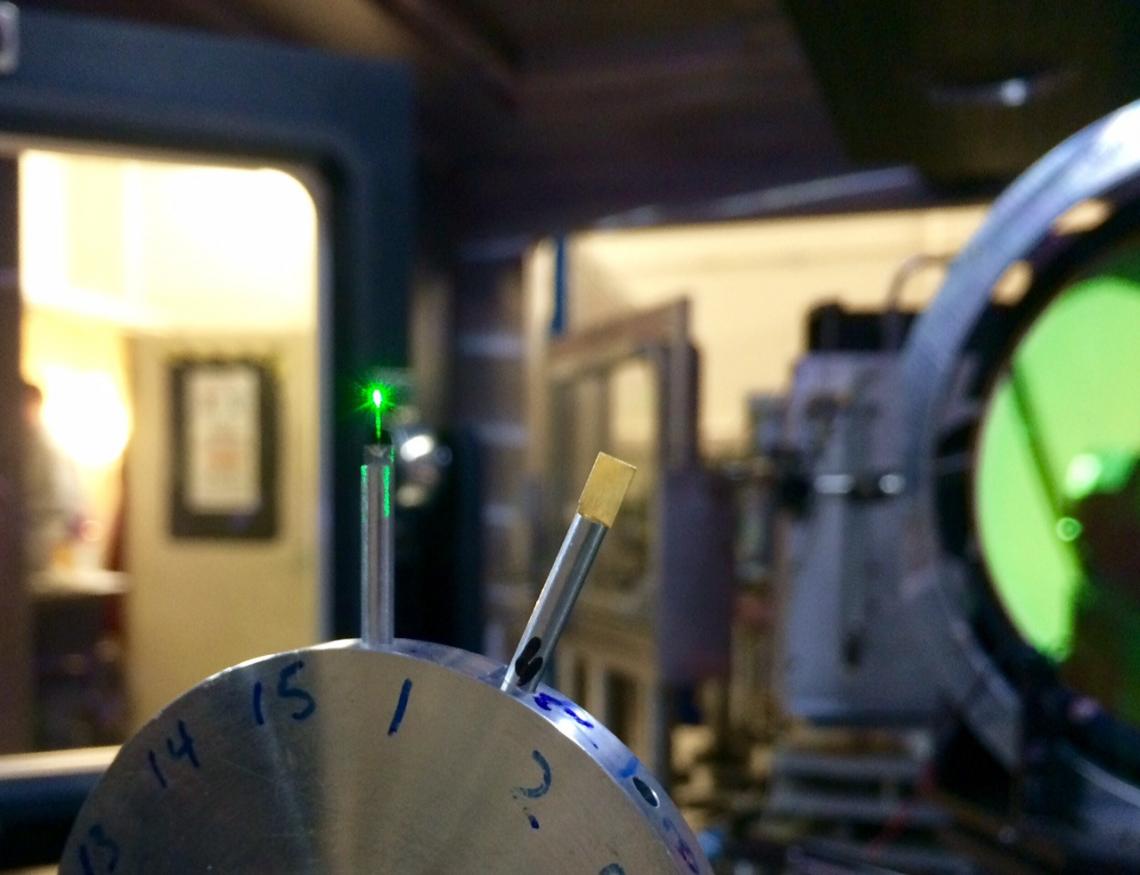
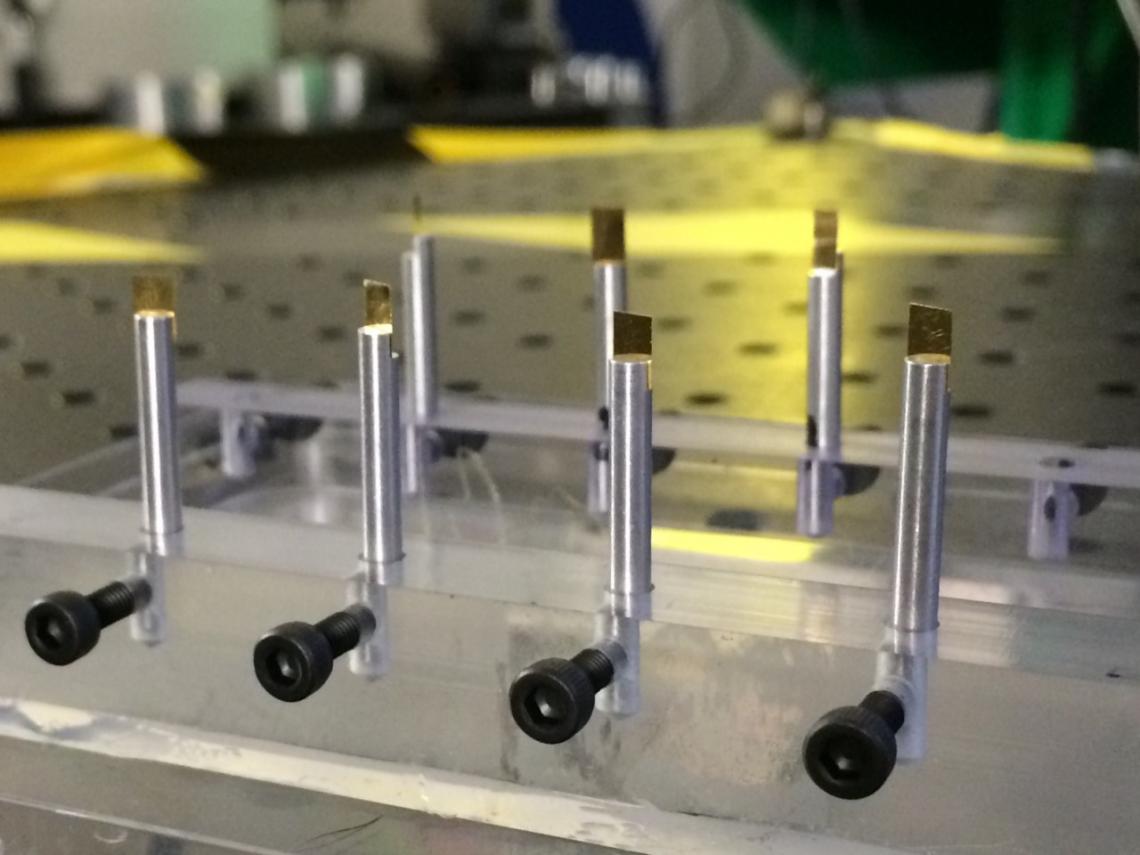
In the first image you can see a 10 micron thick laboratory grade piece of gold foil and an alignment wire with a laser hitting it. The piece of gold foil will be rotated to be in the path of the Vulcan laser beam to produce x-ray and neutron beams.
How it works:
As the laser hits the gold it turns the front surface into very high temperature plasma. The laser pushes electrons from front surface of plasma through the foil. They pop out of the other side and pull out protons behind them. This is essentially the particle accelerator. As these electrons stream through the gold foil they are deflected around the electrons within the material. This change of direction results in x-rays being produced. These are called bremsstrahlung x-rays, this means braking radiation in German. As the electron decelerates it loses kinetic energy, which is converted into a photon (x-rays are a type of photon).
The neutron beam is created as the protons interact with neutrons in the nucleus of a catcher material (lithium or copper usually) and pass energy to the neutron. This flies out creating a neutron beam. This is often called a pitcher catcher configuration, the pitcher is the laser interaction on the gold foil, this throws the proton (the ball) and the catcher (a chunk of lithium or copper) stops the proton and emits a neutron.
The x-rays produced are high energy and have a very small source point. This means they can image dense materials and achieve very good resolution. The neutron beam is interesting in that it passes really easily through dense materials like lead, but gets absorbed by hydrogen in materials like plastic. So a piece of plastic within a lead box could easily be seen. Unlike x-rays which do almost the opposite (and could see a piece of lead in a plastic box).