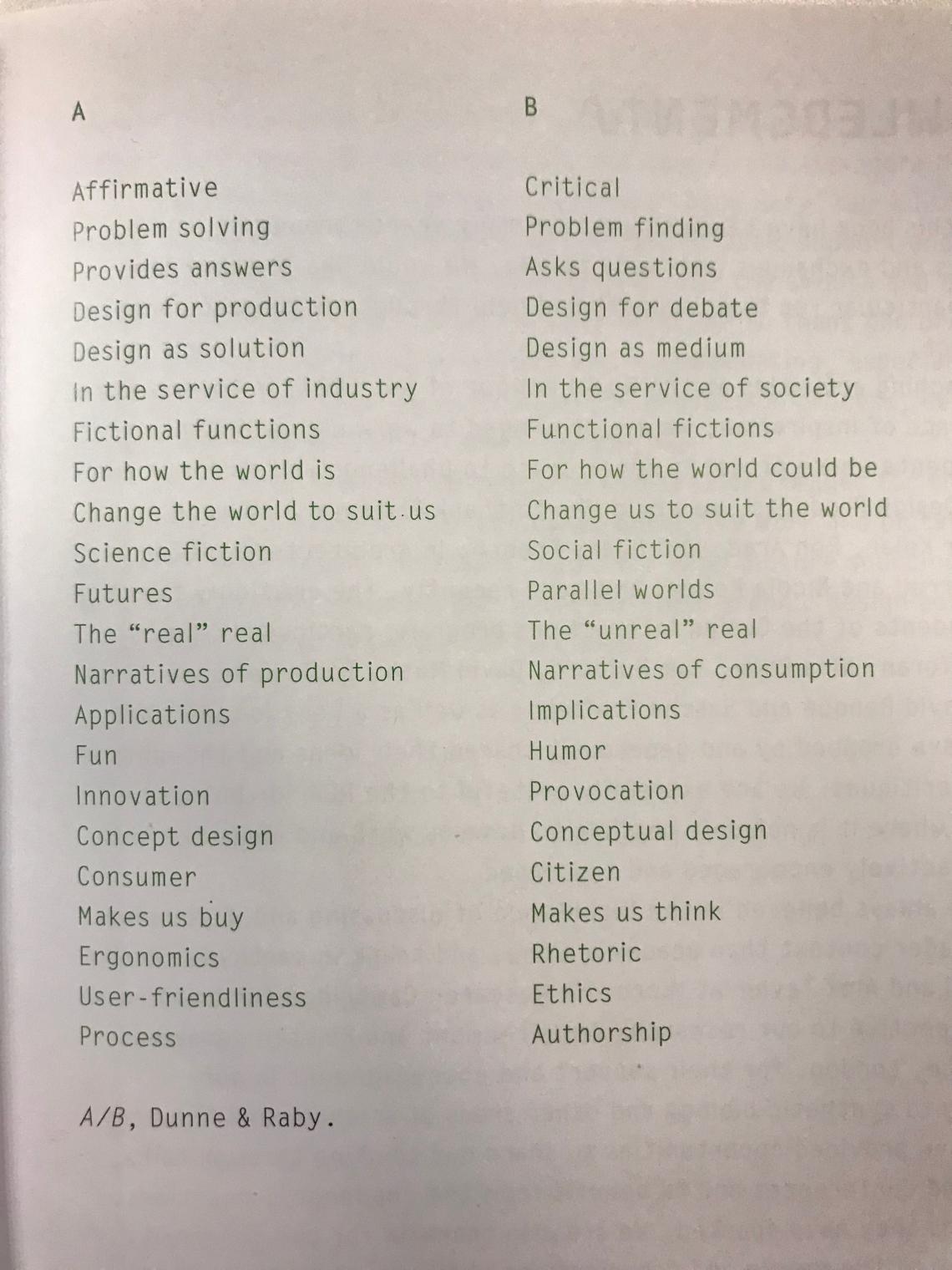
Dunne and Raby's A/B list shows:
"Design as it is usually understood" / "Kind of design that one finds oneself doing"
B is not intended to replace A, it simply adds another dimension.
Dune and Raby's book Speculative Everything is very interesting. I find it full of fascinating work and observations, but its also not something aimed squarely at me. It is full of ideas that are useful for design students of one kind or another, or people who are/were educated that creative output needs to look, or act in a certain way. This book gives lots of alternatives. My own art/sculpture background let me know that anything went and I don't think fine artists have quite the same boundary issues. That being said, there's plenty here that wouldn't have been attempted by most artists, the nature of design training causes certain concepts to be arrived at, opens up new and interesting possibilities.
Of course the book has a framework and assumption about design being a speculative tool (often for scientific/medical applications) that doesn't really fit for some designers who've been included in this field. The very first piece in the book is an artwork/design work by Patrick Stevenson-Keating, who i've shown/talked alongside a number of times in various exhibitions/events. To me he's somewhere between an artist and a designer, and also both at the same time. But I don't think that a categorisation as a Speculative Designer would be his only calling.
The limitations of this kind of thing is that an influential book like this can prescribe an area of activity, or a school of practice. In this case its because the areas of practice it was originally aimed at (design, product design etc) were limited in output, or generally commercial. However the result can be just a new set of boundaries. This however was not Dunne and Raby's intention (as the A/B list was described in the book).