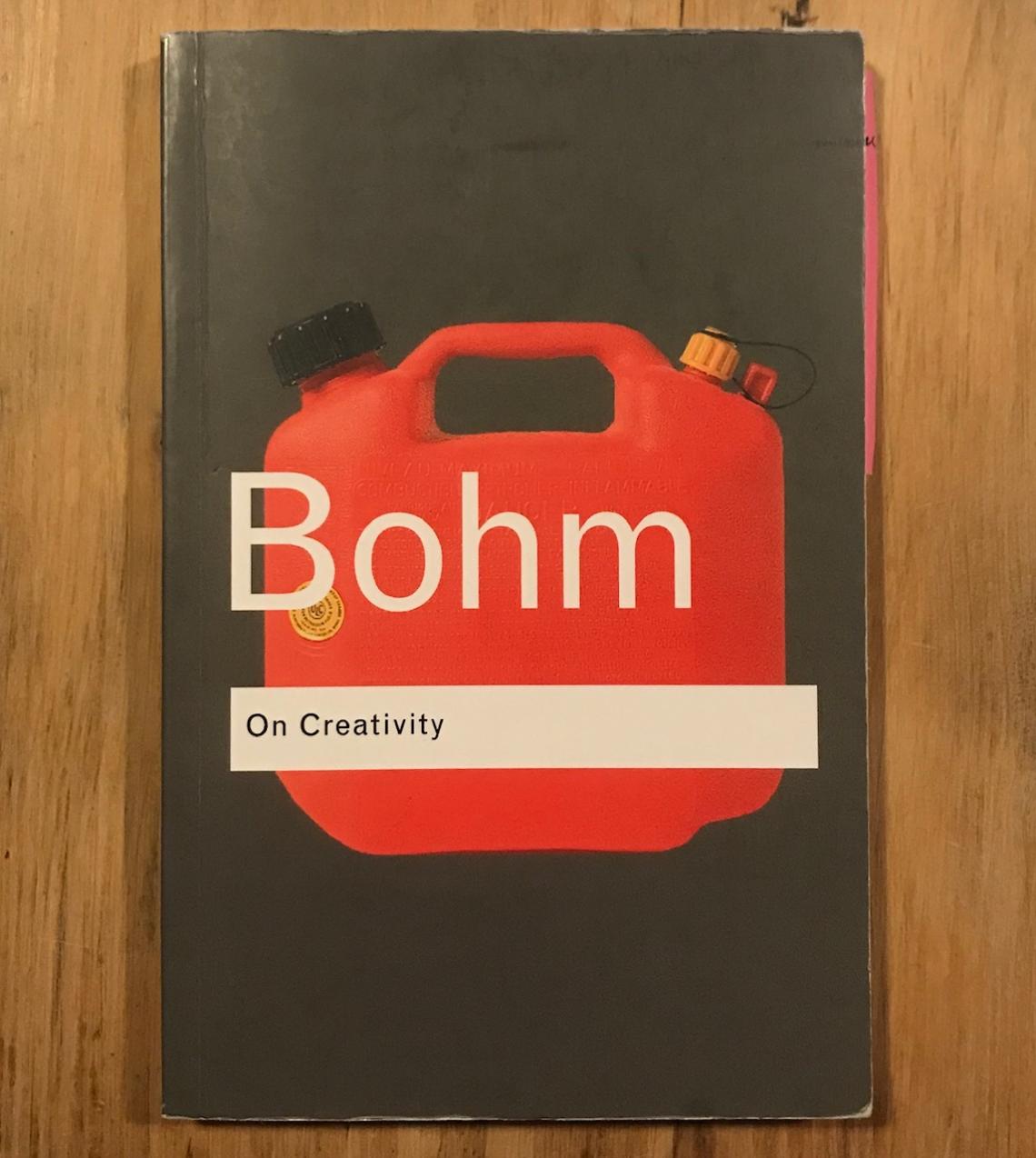
David Bohm asks in his book "On Creativity" why scientists are so deeply interested in their work:
“What he is really seeking is to learn something new that has a certain fundamental kind of significance: a hitherto unknown lawfulness in the order of nature, which exhibits unity in a broad range of phenomena. Thus, he wishes to find in the reality in which he lives a certain oneness and totality, or wholeness, constituting a kind of harmony that is felt to be beautiful. In this respect, the scientist is perhaps not basically different from the artist, the architect, the musical composer, etc., who all want to create this sort of thing in their work.” (Bohm, 2010)
The impetus for my work comes from the same place that Bohm comments upon, a desire to express something in its totality and present its beauty.
In the chapter "On the Relationships of Science and Art" Bohm talks about "truth" in science, art and daily life and the "cross-disciplinary implications of paradigm alterations." What I find especially interesting is the discussion of the activities of science and art in relation to fundamental aspects of human experience. I have long felt it evident that there is an innate desire to be curious and search for truth in humans. This truth can often be related to beauty, or beauty can signify truth.
In early humanity the "underlying impulses that we now pursue separately as science, art, and religion would likely have been one unified movement of perception and response to the surrounding world". This underlying relatedness still exists, "but requires attention and inquiry in a manner fruitful for modern times."
There is a deeper relationship in truth between art and science suggested by Bohm, "a relation that is grounded in the very fabric of experience". Bohm points out that scientific theories do not reflect an "objectively certifiable world". Rather its increasingly understood that "each theory and each instrument selects certain aspects of a world that is infinite, both qualitatively and qantitatively, in its totality." The net result is that science cannot provide "simple reflections of the world as it is". What science does provide is paradigms "simplified but typical examples that abstract relevant features of the world"
Bohm uses the word beauty to discuss the relationship between art and science.
"Most scientists (and especially the most creative ones, such as Einstein, Poincaré, Dirac, and others like them) feel very strongly that the laws of the universe, as disclosed thus far by science, have a very striking and significant kind of beauty, which suggests that deeply they do not really look at the universe as a mere mechanism. Here, then, is a possible link between science and art, with the latter being centrally oriented towards beauty.
Now, there is a common notion that beauty is nothing more than a subjective response of man, based on the pleasure that he takes in seeing what appeals to his fancy. Nevertheless, there is much evidence that beauty is not an arbitrary response that happens to tickle us in a pleasing way. In science, for example, one sees and feels the beauty of a theory only if the latter is ordered, coherent, harmonious with all parts generated naturally from simple principles and with these parts working together to form a unified total structure. But these properties are necessary not only for the beauty of a theory, but also for its truth."