science.am

Main navigation

  • text
  • lab
  • About

SCIENCE.AM is a project by Alistair McClymont to document ongoing research into art and science. To investigate the similarity between scientists and artists. The hypothesis is that both ultimately search for truth and both see beauty in that truth.

The SCIENCE.AM website is a project to document ongoing research into art and science. This is a full collection of posts related to these projects.

SCIENCE.TEXT contains writing on science, art and other influences.

SCIENCE.LAB is a place where experiments, tests, records of activity are recorded.

find out more about this project and Alistair McClymont and SCIENCE.AM on the ABOUT page

Dawkins on Keats and Feynman on beauty

text |
October 21st, 2018

Richard Dawkins begins his book Unweaving the Rainbow by explaining the title, taken from Lamia by Keats. Dawkins suggests that Keats believed Newton had destroyed all the poetry of the rainbow by reducing it to the prismatic colours, inferring an incompatibility between the arts and science. Dawkins argues the opposite and talks of the beauty in the scientific process:

“The feeling of awed wonder that science can give us is one of the highest experiences of which the human psyche is capable. It is a deep aesthetic passion to rank with the finest that music and poetry can deliver…
Welding the test object for the Vulcan laser

lab |
October 20th, 2018

Fabricating aluminium cubes for the Vulcan laser

Aluminium is relatively invisible to xrays, the test object was designed to hide something in a box that was completely welded shut. Inside the box is an object that ended up in the research paper based on this experiment

Two Cultures by C.P. Snow - various appraisals

text |
October 19th, 2018

'"Snow or Leavis? The bland scientism of The Two Cultures or, violent and ill-mannered, the one-track, moralistic literarism of the Richmond Lecture?"--that was the choice offered by Aldous Huxley's Literature an Science, published in 1963, four years after Snow's Rede Lecture.' (Ray Porter)

I discovered Ray Porter's essay The Two Cultures Revisited after looking for references to Aldous Huxley's Literature and Science. Quite a joy to find as its provides interesting discussion and background to C.P. Snow's famous essay.

Ray Porter manages to outline in his essay a number…

What is a scientist and what is science, from a discussion with Dr Ceri Brenner and Prof David Neely

text |
October 17th, 2018

I met Dr Ceri Brenner and Prof David Neely at the Central Laser Facility (CLF), part of the Rutherford Appleton Laboratory on 16th October 2018. This visit was to follow up on previous collaborations, talk about future projects and to discuss art and science generally.

Topics discussed (paraphrased/bulleted rather than quoted):

AM: How would you define a scientist, or what is scientific research?

CB: 

Asking a question

Asking a question thats never been asked before

Pushing forward the sphere of knowledge

Physicist's training shows…

Truth and Beauty Markus Gabriel, Sabine Hossenfelder, Roger Penrose

text |
October 10th, 2018

https://iai.tv/video/truth-and-beauty

A fascinating debate on truth and beauty by Markus Gabriel, Sabine Hossenfelder, Roger Penrose


From the website:

Dirac wrote "It's more important to have beauty in one's equations than to have them fit experiment". However, many argue that simple laws can never encapsulate reality. Do elegance and beauty reflect our human way of understanding the world, meaning simple theories are always prized? Can the complexity of existence ever be fully understood? Or is simplicity the key to being able to explain life and the…

art and science simultaneously - initial propositions

text |
September 28th, 2018

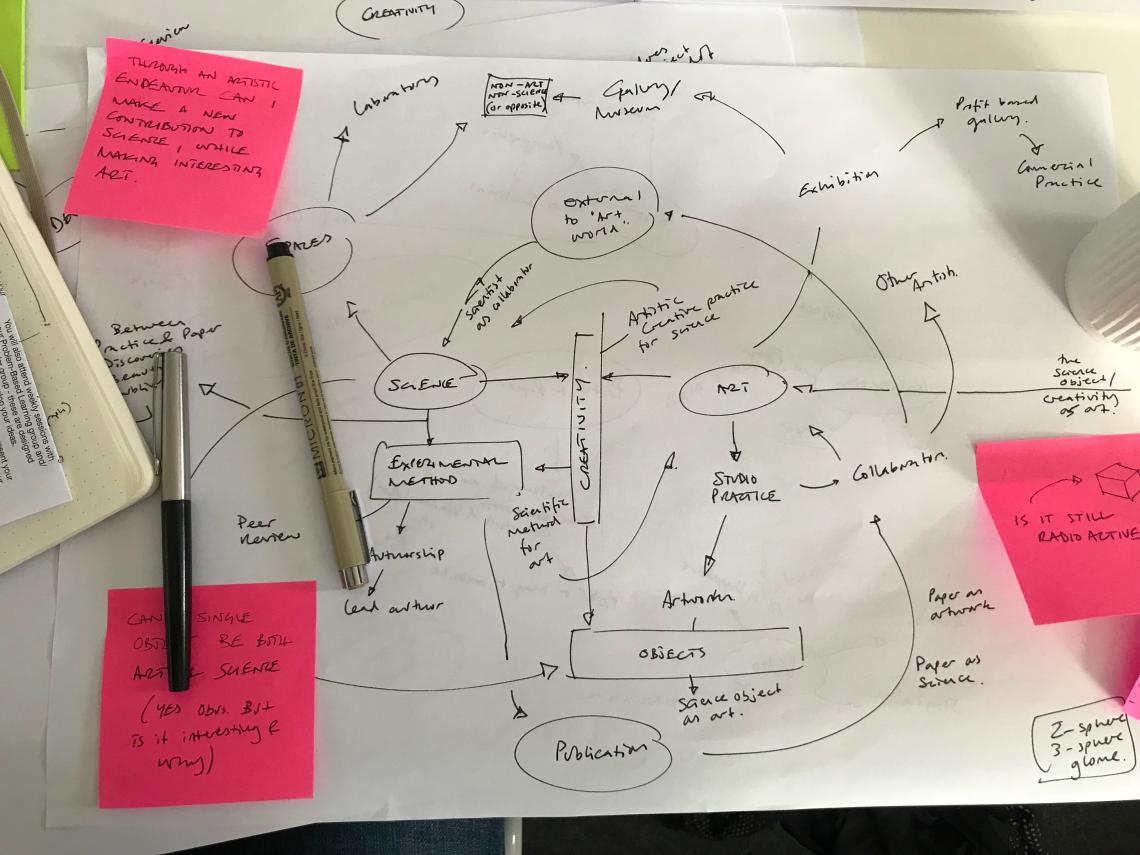
Can an object be made that is simultaneously science and art. Having useful contributions in both fields?

What would happen if I call myself and artist and a physicist?

Through artistic endeavour can i make a new contribution to science, while making interesting art?

An art and science map

text |
September 28th, 2018

This project has grown out of my studio and academic practice. A number of methods are being used to investigate this practice which you can see detailed in the many posts here. A prime theme is to not presuppose the precise outcomes of the project and to repeatedly reappraise the picture of the fields i'm working in. This diagram is one of many attempts to do so.

Supra Systems Book

text |
September 19th, 2018

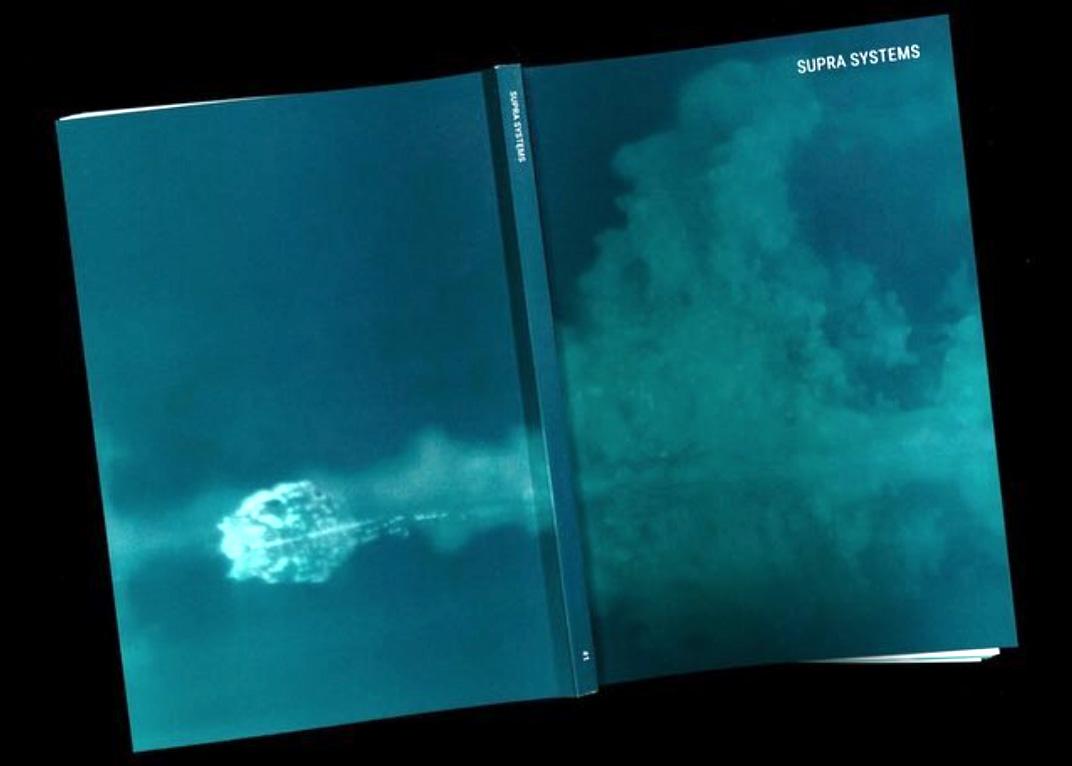
An essay was written for Supra.Systems, a book by Supra Systems Studio. Supra Systems Studio is a research machine from the Design School, London College of Communication, UAL.

The book and the essay are attached to this post. This essay is on page 91 of the book.

x-ray image of chamber

lab |
April 4th, 2015

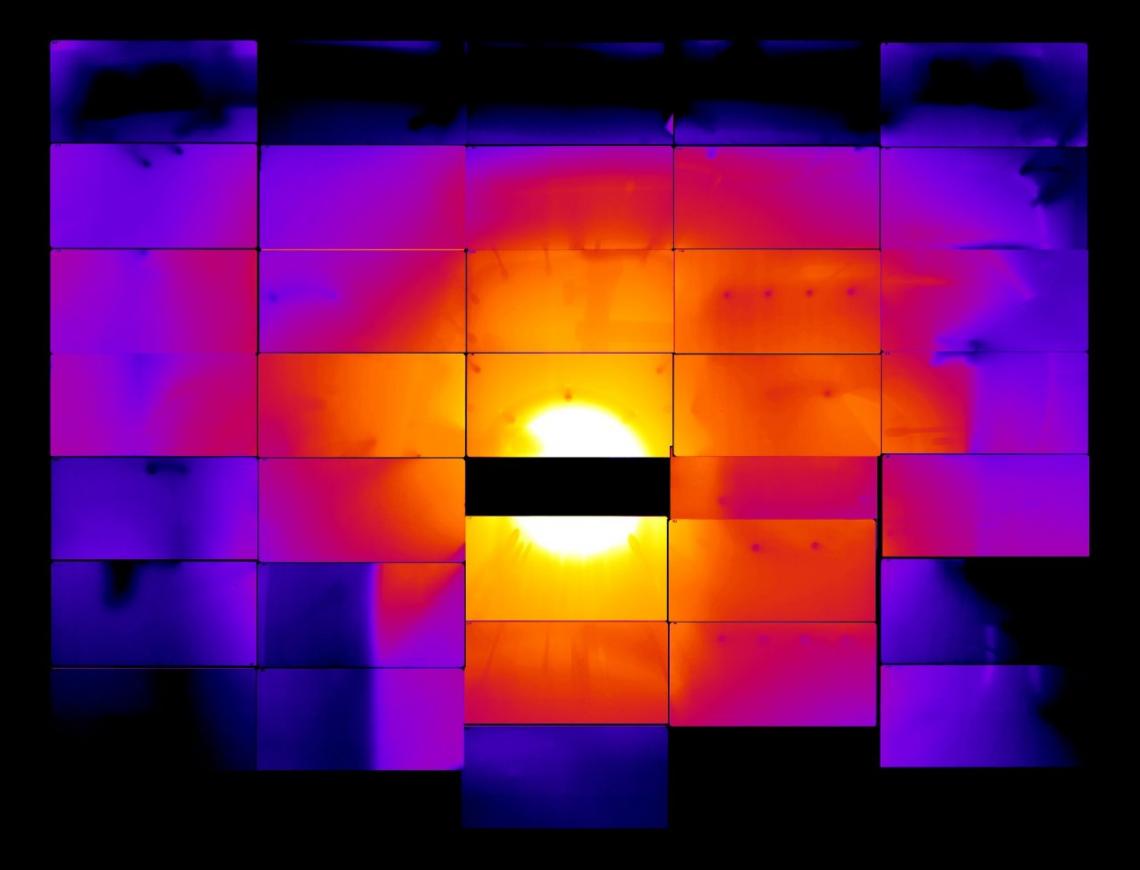
Early days with this image, but here’s some work in progress with a montage of x-ray plates that were attached to the wall of a vacuum chamber. In the centre of which a laser plasma produce high energy x-rays. Over the course of a month I imaged most of the area of the vacuum chamber. Even though the chamber is very thick aluminium its fairly invisible to the x-rays. But you can see the steel nuts and bolts holding the chamber together. What looks like windows in the chamber are actually solid aluminium, but thinner than the surrounding walls (3mm vs up to 30mm).

Long shadows are…

Vulcan Target Area West laser plasma

lab |
April 3rd, 2015

A photograph of the plasma in Beam 8 of the Vulcan Target Area West laser.

This image shows the laser focused on a metal target. The laser is in the infra-red and is invisible in this image. The metal turns into plasma, a very hot 4th state of matter. What you can see is the plasma and two distinct cones of plasma and material ejected from the target from both the front (laser side) of the target and the rear.

This experiment was designed to make highly penetrating x-rays to investigate their imaging properties.

Subscribe to Science Blog - experiments

Science . Alistair McClymont

An ongoing record of art / science research by Alistair McClymont